
1 Corinthians 13 is the thirteenth chapter of the First Epistle to the Corinthians in the New Testament of the Christian Bible. It is authored by Paul of Tarsus and Sosthenes in Ephesus. This chapter covers the subject of "love". In the original Greek, the word ἀγάπη agape is used throughout. This is translated into English as "charity" in the King James version; but the word love is preferred by most other translations, both earlier and more recent.
Text
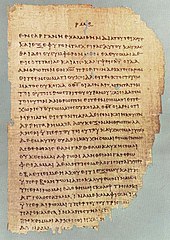
.jpg/250px-POxy1008_(1Co_7.33-8.4).jpg "1 Corinthians 13")
- The original text is written in Koine Greek.
- Some most ancient manuscripts containing this chapter are:
- This chapter is divided into 13 verses.
English version
1 Though I speak with the tongues of men and of angels, but have not love, I have become sounding brass or a clanging cymbal. 2 And though I have the gift of prophecy, and understand all mysteries and all knowledge, and though I have all faith, so that I could remove mountains, but have not love, I am nothing. 3 And though I bestow all my goods to feed the poor, and though I give my body to be burned,[a] but have not love, it profits me nothing.
4 Love suffers long and is kind; love does not envy; love does not parade itself, is not puffed up; 5 does not behave rudely, does not seek its own, is not provoked, thinks no evil; 6 does not rejoice in iniquity, but rejoices in the truth; 7 bears all things, believes all things, hopes all things, endures all things.
8 Love never fails. But whether there are prophecies, they will fail; whether there are tongues, they will cease; whether there is knowledge, it will vanish away. 9 For we know in part and we prophesy in part. 10 But when that which is perfect has come, then that which is in part will be done away.
11 When I was a child, I spoke as a child, I understood as a child, I thought as a child; but when I became a man, I put away childish things. 12 For now we see in a mirror, dimly, but then face to face. Now I know in part, but then I shall know just as I also am known.
13 And now abide faith, hope, love, these three; but the greatest of these is love.
Agape
See main article: Agape
This chapter of Corinthians is one of a number of definitional sources for the word agape when used to refer to divine love.
"Through a glass, darkly"
1 Corinthians 13:12 contains the phrase βλÎπομεν Î³á½°Ï á¼„Ïτι δι' á¼ÏƒÏŒÏ€Ï„Ïου á¼Î½ αἰνίγματι (blepomen gar arti di esoptrou en ainigmati), which is rendered in the KJV as "For now we see through a glass, darkly." This passage has inspired the titles of many works.
The word á¼ÏƒÏŒÏ€Ï„Ïου esoptrou (genitive; nominative: á¼"σοπτÏον esoptron), here translated "glass," is ambiguous, possibly referring to a mirror or a lens. Influenced by Strong's Concordance, many modern translations conclude that this word refers specifically to a mirror. Example English language translations include:
- Now we see but a poor reflection as in a mirror (New International Version)
- What we see now is like a dim image in a mirror (Good News Bible)
Paul's usage is in keeping with rabbinic use of the term ×ספקלרי×" (aspaklaria), a borrowing from the Latin specularia. This has the same ambiguous meaning, although Adam Clarke concluded that it was a reference to specularibus lapidibus, clear polished stones used as lenses or windows. One way to preserve this ambiguity is to use the English cognate, speculum. Rabbi Judah ben Ilai (2nd century) was quoted as saying "All the prophets had a vision of God as He appeared through nine specula" while "Moses saw God through one speculum." The Babylonian Talmud states similarly "All the prophets gazed through a speculum that does not shine, while Moses our teacher gazed through a speculum that shines."
There are two other passages from 1 Corinthians 13 which have been notably influential.
Firstly, verse 11: "When I was a child, I spoke as a child, I understood as a child, I thought as a child: but when I became a man, I put away childish things" (KJV).
U.S. President Barack Obama referenced verse 11 in his inaugural address to the nation on January 20, 2009.
Secondly, verse 13, in praise of the Theological virtues:
- νυνὶ δὲ μÎνει πίστις, á¼Î»Ï€á½¶Ï‚, ἀγάπη, Ï„á½° Ï„Ïία ταῦτα, μείζων δὲ τοÏτων ἡ ἀγάπη.
- "And now faith, hope, and love abide, these three; and the greatest of these is love." (NRSV)
Verse 13 is paraphrased in country singer Alan Jackson's 2001 hit Where Were You (When the World Stopped Turning).
British Prime Minister Tony Blair read 1 Corinthians 13 at the funeral of Diana, Princess of Wales in 1997.
Adaptations
Soundtrack of the film Three Colors: Blue composed by Zbigniew Preisner features a solo soprano singing the epistole in Greek (in a piece titled "Song for the Unification of Europe").
The paragraphs 1-3 and 12-13 of the text are cited for the fourth song of the Vier ernste Gesänge by Johannes Brahms.
A paraphrase of the text is the basis for the song "Love Is the Law" composed and sung by Australian musician Paul Kelly.
References
External links
- Full chapter at Oremus (NRSV and KJV)
- Full Chapter at BibleGateway.com (NIV)