
Barabbas or Jesus Barabbas (a Hellenization of the Aramaic bar abba ×'ר ××'×, literally "son of the father" or "Jesus, son of the Father" respectively) is a figure in the accounts of the Passion of Christ, in which he is the insurrectionary whom Pontius Pilate freed at the Passover feast in Jerusalem, instead of Jesus.
According to the four canonical gospels and the non-canonical Gospel of Peter there was a prevailing Passover custom in Jerusalem that allowed or required Pilate, the praefectus or governor of Judea, to commute one prisoner's death sentence by popular acclaim, and the "crowd" (ochlos), "the Jews" and "the multitude" in some sources, were offered a choice of whether to have either Barabbas or Jesus released from Roman custody. According to the Synoptic Gospels of Matthew, Mark, and Luke, and the accounts in John and the Gospel of Peter, the crowd chose Barabbas to be released and Jesus of Nazareth to be crucified. Pilate is portrayed as reluctantly yielding to the insistence of the crowd. A passage found only in the Gospel of Matthew has the crowd saying, "Let his blood be upon us and upon our children."
The story of Barabbas has special social significance because it has historically been used to lay the blame for the crucifixion of Jesus on the Jews, and to justify antisemitismâ€"an interpretation, known as Jewish deicide, dismissed by Pope Benedict XVI in his 2011 book Jesus of Nazareth, in which he changes the translation of "ochlos" in Matthew to mean the "crowd", rather than to mean the Jewish people.
Biblical account
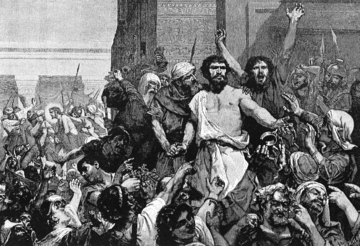
Matthew refers to Barabbas only as a "notorious prisoner". Mark and Luke further refer to Barabbas as one involved in a stasis, a riot. Robert Eisenman states that John 18:40 refers to Barabbas as a lÄ"stÄ"s ("bandit"), "the word Josephus always employs when talking about Revolutionaries".
Three gospels state that there was a custom at Passover during which the Roman governor would release a prisoner of the crowd's choice; Mark 15:6, Matthew 27:15, and John 18:39. Later copies of Luke contain a corresponding verse (Luke 23:17), although it is not present in the earliest manuscripts, and may be a later gloss to bring Luke into conformity.
No custom of releasing prisoners in Jerusalem at Passover or any other time is recorded in any historical document other than the gospels.
Name

Barabbas's name appears as bar-Abbas in the Greek texts of the gospels. It is derived ultimately from the Aramaic ×'ר-××'×, Bar-abbâ, "son of the father". Some ancient manuscripts of Matthew 27:16â€"17 have the full name of Barabbas as "Jesus Barabbas" and this was probably the name as originally written in the text. Early church father Origen was troubled by the fact that his copies of the gospels gave Barabbas' name as "Jesus Barabbas" and declared that since it was impossible he could have had such a holy name, "Jesus" must have been added to Barabbas' name by a heretic. It is highly likely that later scribes, copying the passage, removed the name "Jesus" from "Jesus Barabbas" to avoid dishonour to the name of Jesus the Messiah.
Abba has been found as a personal name in a 1st-century burial at Giv'at ha-Mivtar, and Abba also appears as a personal name frequently in the Gemara section of the Talmud, dating from AD 200â€"400. It could be argued that these findings support "Barabbas" being used to indicate the son of a person named Abba or Abbas (a patronymic). But, ultimately, he is known as Barabbas, not Barabba.
Other interpretations

According to historian Max Dimont, the story of Barabbas as related in the gospels lacks credibility from the Roman standpoint, as it presents the Roman authority, Pontius Pilate, backed by overwhelming military might, being cowed by a small crowd of unarmed civilians into releasing a prisoner condemned to death for insurrection against the Roman empire. Any Roman governor who had done that would have swiftly faced execution himself, according to Dimont. Benjamin Urrutia, co-author of The Logia of Yeshua: The Sayings of Jesus, agrees with a well known theory in biblical scholarship as presented for instance by Hyam Maccoby, which says that Yeshua Bar Abba or Jesus Barabbas must be none other than Jesus of Nazareth, and that the choice between two prisoners is a fiction. However, Urrutia opposes the notion that Jesus may have either led or planned a violent insurrection. Jesus was a strong advocate of "turning the other cheek". Jesus, in this view, must have been the planner and leader of the Jewish nonviolent resistance to Pilate's plan to set up Roman Eagle standards on Jerusalem's Temple Mount. The story of this successful resistance is told by Josephusâ€"who does not say who the leader was, but does tell of Pilate's crucifixion of Jesus just two paragraphs later in a passage whose authenticity is heavily disputed.
Story as a possible parable
This practice of releasing a prisoner is said by Magee and others to be an element in a literary creation of Mark, who needed to have a contrast to the true "son of the father" in order to set up an edifying contest, in a form of parable.
Dennis R. MacDonald, in The Homeric Epics and the Gospel of Mark, notes that a similar episode to the one that occurs in Markâ€"of a crowd picking one figure over another figure similar to the otherâ€"occurred in The Odyssey, where Odysseus entered the palace disguised as a beggar and defeated his wife's suitors to reclaim his throne. MacDonald suggests Mark borrowed from this section of The Odyssey and used it to pen the Barabbas tale, only this time Jesus â€" the protagonist â€" loses to highlight the cruelty of Jesus' persecutors. However, this theory is rejected by other scholars.
Depictions in fiction
.jpg/220px-Barabbas_(2012_film).jpg "Barabbas")
- Barabbas, a 1950 novel by Nobel Prize winner Pär Lagerkvist
- Barabbas, a 1953 Swedish film adaptation of the 1950 novel directed by Alf Sjöberg
- Barabbas, a 1961 film adaptation of the 1950 novel, directed by Richard Fleischer and starring Anthony Quinn as Barabbas
- King of Kings, a 1961 film Harry Guardino as Jesus Barabbas
- Barabbas, a 2012 TV adaptation of the 1950 novel, directed by Roger Young and starring Billy Zane as Barabbas
- In Nikos Kazantzakis' book The Last Temptation of Christ, Barabbas is the leader of the Zealots. He later murders the resurrected Lazarus.
- In The Liars' Gospel, a 2012 novel by Naomi Alderman Barabbas is one of the liars â€" a rebel and murderer who tricks Pilate into releasing him, a choice with significant military consequences.
See also
- Biblical criticism
- Historicity of Jesus
- Textual criticism
- Responsibility for the death of Jesus
References
Notes
Bibliography
- Brown, Raymond E. (1994) The Death of the Messiah, Vol. 1. New York: Doubleday
External links
- John Dominic Crossan, "Crowd control": identity, purpose and size of "the crowd" in Mark and its adapted purposes in Luke and John, on the occasion of the Mel Gibson film of 2004.
- Barabbas and "the crowd" in the ballet stage
- Paul-Louis Couchoud & Robert Stahl, "Jésus Barabbas", in Premiers écrits du Christianisme (Paris, 1930), pp. 139â€"161. English transl. Jake Jones IV, "Jesus Barabbas", in Radikalkritik, Classics.
