
The New Testament describes James, Joseph (Joses), Judas (Jude) and Simon as brothers of Jesus. Also mentioned, but not named, are sisters of Jesus. Some scholars argue that these brothers, especially James, held positions of special honor in the early Christian church. Antidicomarianites and many critical scholars claim that these brothers and sisters refer to the biological children of Mary and Joseph.
Followers of the Catholic, Eastern Orthodox and Oriental Orthodox traditions, as well as some Anglicans, believe in the perpetual virginity of Mary, as did the Protestant leaders Martin Luther, Huldrych Zwingli, and John Wesley. Those who hold this belief reject the claim that Jesus had blood siblings and maintain that these brothers and sisters received this designation because of their close association with the family of Jesus, and are actually either his cousins or children of Joseph from a previous marriage.
In the 3rd century, blood relatives of Jesus, without explicit reference to brothers or sisters, were called the desposyni, from the Greek δεσπόσυνοι, plural of δεσπόσυνος, meaning "of or belonging to the master or lord". The term was used by Sextus Julius Africanus, a writer of the early 3rd century.
Jesus' brothers and sisters
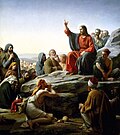
The Gospel of Mark 6:3 and the Gospel of Matthew 13:55-56 state that a James, Joses (or Joseph), Judas, and Simon were the brothers of Jesus, the son of Mary. The same verses also mention unnamed sisters of Jesus. Another verse in the Epistle to the Galatians 1:19 mentions seeing James, "the Lord's brother", and none other of the apostles except Peter, when he went to Jerusalem after his conversion. The "brothers of the Lord" are also mentioned, alongside (but separate from) Cephas and the apostles in 1 Corinthians 9:5, in which it is mentioned that they had wives. Some scholars go on to claim that Jesus' relatives may have held positions of authority in the Jerusalem area until Trajan excluded Jews from the new city that he built on its ruins.
That the children were children of both Mary and Joseph was accepted by some members of the early Christian church, including Tertullian (c. 160 â€" c. 225). The 3rd-century Antidicomarianites ("Anti-Mary") maintained that, when Joseph became Mary's husband, he was a widower with six children, and that he had normal marital relations with Mary, but they later held that Jesus was not born of these relations. The Bonosians were followers of Bonosus, a bishop who in the late 4th century held that Mary had other children after Jesus, a view for which the other bishops of his province condemned him. Jovinian, and various Arian teachers such as Photinus held a similar view. When Helvidius proposed it, again in the late 4th century, Jerome, apparently representing the general opinion of the Church, maintained that Mary remained always a virgin; he held that those who were called the brothers and sisters of Jesus were actually children of her sister, another Mary, whom he considered the wife of Clopas. The terms "brothers" and "sisters" as used in this context are open to different interpretations, and have been argued to refer to children of Joseph by a previous marriage (the view of Epiphanius of Salamis), Mary's sister's children (the view of Jerome), or children of Clopas, who according to Hegesippus was Joseph's brother, and of a woman who was not a sister of Mary, the mother of Jesus (a modern proposal). Certain critical scholars say that the doctrine of perpetual virginity has obscured recognition that Jesus had siblings.
As church leaders

According to Robert Funk, the Gospel of Mark shows that Jesus' mother and brothers were at first sceptical of Jesus' ministry but later became part of the Christian movement. James, "the Lord's brother", presided over the Jerusalem church after the apostles dispersed and other kinsmen probably exercised some leadership among the Christians in the area until the emperor Hadrian built Aelia Capitolina on the ruins of Jerusalem and banished all Jews from there (c. 135), after which point the Jerusalem Christians were entirely of Gentile origin. Traditionally it is believed the Jerusalem Christians waited out the Jewishâ€"Roman wars (66â€"135) in Pella in the Decapolis. The Jerusalem Sanhedrin relocated to Jamnia sometime c. 70.
At an earlier stage James "the Lord's brother" (Galatians 1:19) is said to have been granted a special appearance by the resurrected Jesus. When Peter the Apostle, a leader of the church in Jerusalem left, it was James who became the principal authority and was held in high regard by the Jewish Christians. Hegesippus reports that he was executed by the Sanhedrin in 62.
Sextus Julius Africanus's reference to "Desposyni" (blood relatives of Jesus) is preserved in Eusebius of Caesarea's Ecclesiastical History:
For the relatives of our Lord according to the flesh, whether with the desire of boasting or simply wishing to state the fact, in either case truly, have handed down the following account... But as there had been kept in the archives up to that time the genealogies of the Hebrews as well as of those who traced their lineage back to proselytes, such as Achior the Ammonite and Ruth the Moabitess, and to those who were mingled with the Israelites and came out of Egypt with them, Herod, inasmuch as the lineage of the Israelites contributed nothing to his advantage, and since he was goaded with the consciousness of his own ignoble extraction, burned all the genealogical records, thinking that he might appear of noble origin if no one else were able, from the public registers, to trace back his lineage to the patriarchs or proselytes and to those mingled with them, who were called Georae. A few of the careful, however, having obtained private records of their own, either by remembering the names or by getting them in some other way from the registers, pride themselves on preserving the memory of their noble extraction. Among these are those already mentioned, called Desposyni, on account of their connection with the family of the Saviour. Coming from Nazara and Cochaba, villages of Judea, into other parts of the world, they drew the aforesaid genealogy from memory and from the book of daily records as faithfully as possible. Whether then the case stand thus or not no one could find a clearer explanation, according to my own opinion and that of every candid person. And let this suffice us, for, although we can urge no testimony in its support, we have nothing better or truer to offer. In any case the Gospel states the truth." And at the end of the same epistle he adds these words: "Matthan, who was descended from Solomon, begat Jacob. And when Matthan was dead, Melchi, who was descended from Nathan begat Eli by the same woman. Eli and Jacob were thus uterine brothers. Eli having died childless, Jacob raised up seed to him, begetting Joseph, his own son by nature, but by law the son of Eli. Thus Joseph was the son of both.
Eusebius has also preserved an extract from a work by Hegesippus (c.110â€"c.180), who wrote five books (now lost except for some quotations by Eusebius) of Commentaries on the Acts of the Church. The extract refers to the period from the reign of Domitian (81â€"96) to that of Trajan (98â€"117), and includes the statement that two Desposyni brought before Domitian later became leaders of the churches:
There still survived of the kindred of the Lord the grandsons of Judas, who according to the flesh was called his brother. These were informed against, as belonging to the family of David, and Evocatus brought them before Domitian Caesar: for that emperor dreaded the advent of Christ, as Herod had done.
So he asked them whether they were of the family of David; and they confessed they were. Next he asked them what property they had, or how much money they possessed. They both replied that they had only 9000 denaria between them, each of them owning half that sum; but even this they said they did not possess in cash, but as the estimated value of some land, consisting of thirty-nine plethra only, out of which they had to pay the dues, and that they supported themselves by their own labour. And then they began to hold out their hands, exhibiting, as proof of their manual labour, the roughness of their skin, and the corns raised on their hands by constant work.
Being then asked concerning Christ and His kingdom, what was its nature, and when and where it was to appear, they returned answer that it was not of this world, nor of the earth, but belonging to the sphere of heaven and angels, and would make its appearance at the end of time, when He shall come in glory, and judge living and dead, and render to every one according to the course of his life.
Thereupon Domitian passed no condemnation upon them, but treated them with contempt, as too mean for notice, and let them go free. At the same time he issued a command, and put a stop to the persecution against the Church.
When they were released they became leaders of the churches, as was natural in the case of those who were at once martyrs and of the kindred of the Lord. And, after the establishment of peace to the Church, their lives were prolonged to the reign of Trajan.
Degree of consanguinity between Jesus and his brothers
The New Testament names James the Just, Joses, Simon, and Jude as the brothers (Greek adelphoi) of Jesus (Mark 6:3, Matthew 13:55, John 7:3, Acts 1:14, 1Â Corinthians 9:5.)
The etymology of the word "brother" (adelphos) originally comes from "of the same womb" ("a-delphys"), though, in New Testament usage, the Christian and Jewish meaning of "brethren" is wider, and is applied even to members of the same religious community. There is disagreement from an early date over whether the Greek term adelphos applied in these accounts to people described as adelphoi of Jesus means that they full brothers, half brothers, stepbrothers, or cousins. According to some scholars the most natural inference from the New Testament is that the adelphoi were children of Mary and Joseph born after Jesus. Tertullian, possibly Hegesippus, and Helvidius accepted this view. In reference to this it is occasionally noted that James (Jacob Iakobos) as oldest of the brothers takes the name of Joseph's father (also James, Iakobos in the Solomonic genealogy of Jesus in Matthew), when in Bible times the grandson occasionally gets the name of the grandfather.
The term "brother" (adelphos) is distinct in Greek from "cousin" (anepsios), and the second-century Christian writer Hegesippus distinguishes between those who were "cousins" of Jesus (anepsioi) and his "brothers."
Relationship of Jesus' siblings to Mary
By the 3rd century the doctrine of the perpetual virginity of Mary was well established and defended by Hippolytus, Eusebius and Epiphanius, important early Christian theologians. Much of the church therefore did not accept that Mary could have had any children apart from Jesus. Eusebius and Epiphanius held that these men were Joseph's sons from (an unrecorded) former marriage. Jerome, another important early theologian, also followed the perpetual virginity doctrine, but argued that these adelphoi were sons of Mary's sister, whom Jerome identified as Mary of Cleopas. The Oxford Dictionary of the Christian Church mentions that a modern scholar, whom it does not identify, has proposed that these men were the sons of Clopas (Joseph's brother according to Hegesippus) and Mary, the wife of Cleopas (not necessarily referring to Jesus' mother's sister).
Roman Catholic and Eastern Orthodox doctrine is that Mary was a perpetual virgin; this view was also held by many of the early Protestants, including Luther and Zwingli, as well as John Wesley, the 18th century Methodist leader. Indeed, the majority of early Christians seem to have left this doctrine completely unquestioned. The Roman Catholic Church, following Jerome, conclude that the adelphoi were Jesus' cousins, but the Eastern Orthodox, following Eusebius and Epiphanius, argue that they were Joseph's children by his (unrecorded) first wife.
Modern Protestants view the adelphoi as Jesus' half-brothers or do not specify, since the accounts in the Gospels do not speak of Mary's relationship to them but only to Jesus.
In the Book of Genesis, all the other sons of Jacob are repeatedly called brothers of Joseph, although they were children of different mothers. Similarly, in the Second Book of Samuel Tamar is described as a sister both of Amnon and of Absalom, though these were David's sons by different mothers.
A small number of early groups, notably some Ebionites, rejected belief in the virgin birth of Jesus and held that Joseph was the biological father of Jesus, making the brothers of Jesus full brothers.
Scholars of the Jesus Seminar suggest that the doctrine of Mary's perpetual virginity has impeded recognition that Jesus had full brothers and sisters.
Family trees and pedigrees
Aside from the genealogies of Jesus in the Gospel of Luke and Gospel of Matthew, there have been several presentations of theories about a family tree of Jesus' immediate nuclear family:
In the article "The 'Brethren of the Lord'" in A Catholic Commentary on Holy Scripture, gives the following tree.
Anne=Joachim Jacob | | | ____________________________ | | | | | | Mary=Joseph Clopas=another Mary | | Jesus _____________________________ | | | | | | | | James Joses Simon Jude
In a book produced by Augsburg Fortress, the official publishing house of the Evangelical Lutheran Church in America, John J. Rousseau and Rami Arav present the following diagram of relationships in line with their view that the brothers and sisters mentioned were children of Joseph and Mary, whom they believe to have had marital relations in the at least twelve years that Joseph lived after the birth of Jesus, although the Luke 2 account of their journey to the temple when Jesus was twelve makes no mention of other children in the caravan.
__________________________________________ | | | | Mary=Joseph Cleopas=another Mary | | |______________________________________ | | | | | | | | Simeon | | | | | | | d. 106 Jesus James Joses Simon Sister Sister Jude d.62 | | Menahem Jude ____|____ | | | Elzasus James Zoker | ? Nascien | Bishop Judah Kyriakos fl. c. 148â€"49.
James Tabor's theory
The following represents James Tabor's attempted reconstruction. The view has not found wide support among other scholars.
Matthat bar Levi | Eleazar | | Heli/Eliakim | | Matthan _______|___________ | | | | | | Mary + GOD = Joseph (1st) = Clophas (2nd) | | | ______________________|_________ Jesus | | | | | | 5 BCE â€" CE 28. | | | | | | James Jose Judas Simon Mary Salome d. CE 62 | d. CE 101 ____|____ | | | | Zechariah James alive in the reign of Domitian
Interpersonal relationship with Jesus in the New Testament
According to the Synoptic Gospels, and particularly the Gospel of Mark, Jesus was once teaching a large crowd near the home of his own family, and when this came to their attention, his family went to see him and "they" (not specified) said that Jesus was "...out of his mind."
Then he went home; and the crowd came together again, so that they could not even eat. When his family heard it, they went out to restrain him, for people were saying, ‘He has gone out of his mind.’
And he comes back home, and the crowd gathers again, to the point where they couldn't even eat a meal. Hearing of that, his folks came out [from Nazareth] intending to take him away, saying, 'He's gone mad!'
And He came home, and the crowd gathered again, to such an extent that they could not even eat a meal. When His own people heard of this, they went out to take custody of Him; for they were saying, 'He has lost His senses.'
In the narrative of the Synoptic Gospels, and of the Gospel of Thomas, when Jesus' mother and adelphoi are outside the house that Jesus is teaching in, Jesus tells the crowd that whoever does what God wills would constitute his mother and adelphoi. According to Kilgallen, Jesus' answer was a way of underlining that his life had changed to the degree that his family were far less important than those that he teaches about the Kingdom of God. The Gospel of John states that Jesus' adelphoi did not believe in him, because he would not perform miracles with them at the Feast of Tabernacles.
Some scholars have suggested that the portrayal in the Gospel of Mark of the initial rejection of Jesus by his family may be related to the tension between Paul of Tarsus and Jewish Christians, who held Jesus' family in high regard, for example at the Council of Jerusalem.
In popular culture
The idea of Jesus having relatives features in the following tales:
- Dogma (1999) relies on the idea that Jesus had half-siblings conceived by Mary with Joseph, with protagonist Bethany Sloane being Jesus's great-great-great-great-great-grandniece.
- The Good Man Jesus and the Scoundrel Christ by Philip Pullman presents "Jesus" and "Christ" as distinct people, with Jesus preaching the message while his brother Christ calculated how best to use that message to influence others.
- The Red Dwarf series ten episode "Lemons" includes the idea that Judas was actually the twin brother of Jesus, who died in his place to 'fake' the resurrection and spread Jesus' gospel.
- Robert Rankin introduced two siblings for Jesus in his novel Waiting for Godalming; Christine, Jesus's twin sister, and Colin, his half-brother (Conceived with God's wife Eartha while he was 'apologising' for his dalliance with Mary), both of whom never made it into the Bible because God gave Jesus copyright control and Bibles were no longer being written by the time Colin was born.
- Anne Rice uses the idea that Jesus had step-siblings from widower Joseph's prior marriage in her two 'Christ the Lord' novels.
References
Bibliography
- Funk, Robert W (1998), The acts of Jesus: the search for the authentic deeds of Jesus, The Jesus Seminar, San Francisco: Harper .
Further reading
- Kilgallen, John J (1989), A Brief Commentary on the Gospel of Mark, Paulist .
- Tabor, James D (2006), The Jesus Dynasty, Simon & Schuster .
- Aslan, Reza (2014), Zealot: The Life and Times of Jesus of Nazareth, HarperCollins Publishers India, ISBNÂ 978-9351360773Â
External links
- "From Jesus to Christ: Jesus' Family Tree", Front line, PBSÂ .
- "The Brethren of the Lord", Catholic Encyclopedia, New advent .