
- Saint Elisabeth redirects here. For other saints of this name, see Elizabeth.
Elizabeth, also spelled Elisabeth (Greek Ἐλισάβετ) or Elisheba (from the Hebrew ×ֱלִישֶ××'Ö·×¢ / ×ֱלִישָ××'Ö·×¢ "My God has sworn"; Standard Hebrew ElišévaÊ¿ ElišávaÊ¿, Tiberian Hebrew ʾÄ"lîšéḇaÊ¿ ʾÄ"lîšÄḇaÊ¿; Arabic أليصاباتAlyassabat), was the mother of John the Baptist and the wife of Zacharias/Zachary, according to the Gospel of Luke.
Biblical narrative
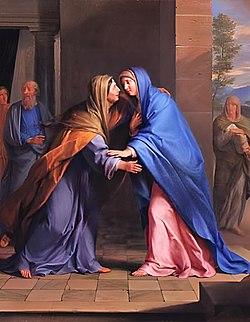
According to the Gospel of Luke, Elisabeth was "of the daughters of Aaron" (1:5). She and her husband Zacharias were "righteous before God, walking in all the commandments and ordinances of the Lord blameless" (1:6-7), but childless. While he was in the temple of the Lord (1:8â€"12), Zacharias was visited by the angel Gabriel:
Zacharias doubted whereby he could know this since both he and his wife were very old. The angel identified himself as Gabriel and told Zacharias that he would be "dumb, and not able to speak" until the words were fulfilled, because he did not believe. When the days of his ministry were complete, he returned to his house (Luke 1:16-23).
According to the account, the angel Gabriel was then sent to Nazareth in Galilee to her "cousin" Mary, then a virgin, espoused to a man called Joseph, and informed her that she would conceive by the Holy Ghost and bring forth a son to be called Jesus. After she was also informed that her "cousin Elisabeth" had begun her sixth month of pregnancy, she travelled to "Hebron, in the hill country of Judah", to visit Elisabeth.(Luke 1:26-40)
Matthew Henry comments, "Mary knew that Elisabeth was with child, but it does not appear that Elisabeth had been told any thing of her cousin Mary's being designed for the mother of the Messiah; and therefore what knowledge she appears to have had of it must have come by a revelation, which would be a great encouragement to Mary." After Mary heard Elisabeth's blessing, she spoke the words now known as the Magnificat (Luke 1:46-55). Again, Henry notes that "it was here, in Hebron, that circumcision was first instituted", and it was here that the LORD turned Abram's name to Abraham when he gave him the covenant of circumcision.
That is the last mention of Elisabeth, who is not mentioned in any other chapter in the Bible. The chapter continues with the prophecy of Zacharias, (known as the Benedictus,) and ends with the note that John "grew, and waxed strong in spirit, and was in the deserts" until his ministry to Israel began; so it is unknown how long Elisabeth and her husband lived after that (Luke 1:65-80).
Apocrypha
Elizabeth is mentioned in several books of the Apocrypha, most prominently in the Protevangelion of James, in which the birth of her son and the subsequent murder of her husband are chronicled.
Sainthood
Elisabeth is revered as a saint in the Roman Catholic Church on November 5, and in the Orthodox and Anglican traditions on September 5, on the same day with her husband Zacharias/Zechariah. She is commemorated as a matriarch in the Calendar of Saints (November 5) of the Lutheran Churchâ€"Missouri Synod and Zacharias is commemorated as a prophet.
In Islam
Elizabeth, the wife of Zachariah, the mother of John the Baptist and cousin of Mary, is an honored woman in Islam. Although Zachariah himself is frequently mentioned by name in the Qur'an, Elizabeth, while not mentioned by name, is referenced. Islamic tradition, like Christianity, gives her the name. She is revered by Muslims as a wise, pious and believing person who, like her cousin Mary, was exalted by God to a high station. She lived in the household of Amram, and is said to have been a descendant of the prophet and priest Aaron.
Zachariah and his wife were both devout and steadfast in their duties. They were, however, both very old and they had no son. Therefore, Zachariah would frequently pray to God for a son. This was not only out of the desire to have a son but also because the great apostle wanted someone to carry on the services of the Temple of prayer and to continue the preaching of the Lord's message after his death.
God cured Elizabeth's barrenness and granted Zachariah a son, Yahya (John the Baptist), who became a prophet. God thus granted the wishes of the couple because of their faith, trust and love for God. In the Qur'an, God speaks of Zachariah, his wife and John describes the three as being humble servants of the LORD:
So We listened to him: and We granted him John: We cured his wife's (Barrenness) for him. These (three) were ever quick in emulation in good works; they used to call on Us with love and reverence, and humble themselves before Us.
See also

- Gospel of Luke
- Visitation (Catholic feast)
- Biblical figures in Islamic tradition
Notes and references
External links
- Stained glass depiction of Elizabeth and Zachary, Cathédrale Saint-Etienne de Bourges