
In Christianity, the Epistle of James (Ancient Greek: Ἰάκωβος IakÅbos), usually referred to simply as James, is a letter (epistle) in the New Testament. The earliest extant manuscripts of James usually date to the mid-to-late third century.
The author identifies himself as "James, a servant of God and of the Lord Jesus Christ" and the epistle is traditionally attributed to James the Just.
There are four views concerning the Epistle of James:
- that the letter was written by James before the Pauline Epistles,
- that the letter was written by James after the Pauline Epistles,
- that the letter is pseudonymous,
- that the letter comprises material originally from James but reworked by a later editor.
Framed within an overall theme of patient perseverance during trials and temptations, the text condemns various sins. The epistle was addressed to "the twelve tribes scattered abroad" (James 1:1), which is generally taken to mean a Jewish Christian audience outside of Palestine.
Composition
_f85r.jpg/220px-Minuscule_319_(GA)_f85r.jpg "Epistle of James")
The epistle may not be a true piece of correspondence between specific parties, but rather an example of wisdom literature formulated as a letter for circulation. The work is considered New Testament wisdom literature because, "like Proverbs and Sirach, it consists largely of moral exhortations and precepts of a traditional and eclectic nature." Similarly, the Catholic Encyclopedia says, "the subjects treated of in the Epistle are many and various; moreover, St. James not infrequently, whilst elucidating a certain point, passes abruptly to another, and presently resumes once more his former argument."
Authorship
The writer calls himself simply "James, a servant of God and of the Lord Jesus Christ."[Jas 1:1] Jesus had two apostles named James, but it is unlikely that either of these wrote the letter. One apostle, James, the son of Zebedee, was martyred about 44 AD. This would be very early for him to have been the writer. The other apostle James, the son of Alphaeus, is not prominent in the Scriptural record, and very little is known about him.
Rather, evidence points to James the brother of Jesus, to whom Jesus evidently had made a special appearance after his resurrection described in the New Testament. This James was prominent among the disciples. The writer of the letter of James identifies himself as "a slave of God and of the Lord Jesus Christ", in much the same way as did Jude, who introduced the Epistle of Jude by calling himself "a slave of Jesus Christ, but a brother of James". (Jas 1:1; Jude 1) Furthermore, the salutation of James’ letter includes the term “Greetings!†in the same way as did the letter concerning circumcision that was sent to the congregations. In this latter instance it was apparently Jesus’ brother James who spoke prominently in the assembly of "the apostles and the older men" at Jerusalem.
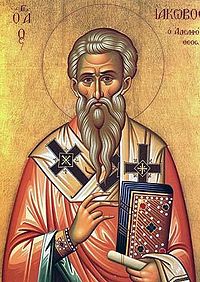
From the middle of the 3rd century, patristic authors cited the Epistle as written by James the Just, a relation of Jesus and first Bishop of Jerusalem. Not numbered among the Twelve Apostles, unless he is identified as James the Less, James was nonetheless a very important figure: Paul described him as "the brother of the Lord" in Galatians 1:19 and as one of the three "pillars of the Church" in 2:9. He is traditionally considered the first of the Seventy Disciples. John Calvin and others suggested that the author was the Apostle James, son of Alphaeus, who was often identified with James the Just. If written by James the Just, the place and time of the writing of the epistle would be Jerusalem, where James resided before his martyrdom in 62.
The Protestant reformer Martin Luther denied it was the work of an apostle and termed it an "epistle of straw" as compared to some other books in the New Testament, not least because of the conflict he thought it raised with Paul on the doctrine of justification (see below).
Many scholars consider the epistle to be written in the late 1st or early 2nd centuries. Among the reasons for this are:
- the author introduces himself merely as "a servant of God and of the Lord Jesus Christ", without invoking any special family relationship to Jesus.
- the cultured Greek language of the Epistle, it is contended, could not have been written by a Jerusalemite Jew. Some scholars argue for a primitive version of the letter composed by James and then later polished by another writer.
- the epistle was only gradually accepted into the canon of the New Testament.
- Some see parallels between James and 1 Peter, 1 Clement, and the Shepherd of Hermas and take this to reflect the socio-economic situation Christians were dealing with in the late 1st or early 2nd century. It thus could have been written anywhere in the Empire where Christians spoke Greek. There are some scholars who argued for Syria.
Content

The United Bible Societies' Greek New Testament divides the letter into the following sections:
Alternative view
There are other approaches to understanding, and reading, the epistle of James. A historical approach begins on different assumptions, and is not content leaving the book as just "New Testament wisdom literature, like a small book of Proverbs", or like a loose collection of random pearls dropped in no particular order onto a piece of string. A 2013 journal article explores a violent historical background behind the epistle and offers the suggestion that it was indeed written by James the brother of Jesus, and therefore written before AD 62, the year of James' murder. The decade of the 50's saw the growth of turmoil and violence in Palestine as Jews became more and more frustrated with corruption, injustice and poverty. It continued into the 60's and four years after the murder of James, war broke out with Rome - a war that would lead to the destruction of Jerusalem and the scattering of the people. The epistle of James is renowned for exhortations on fighting poverty and caring for the poor in practical ways (1:26â€"27; 2:1-4; 2:14-19; 5:1-6), standing up for the oppressed (2:1-4; 5:1-6) and not being "like the world" in the way one responds to evil in the world (1:26-27; 2:11; 3:13-18; 4:1-10). Worldly wisdom is rejected and people are exhorted to embrace heavenly wisdom, which includes peacemaking and pursuing righteousness and justice (3:13-18).
This approach sees the epistle as a real letter with a real immediate purpose: to encourage Christian Jews not to revert to violence in their response to injustice and poverty, but rather to stay focused on doing good, staying holy, and embracing the wisdom of heaven not the wisdom of the world.
Doctrine
Justification
The letter contains the following famous passage concerning salvation and justification:
14What good is it, my brothers, if someone says he has faith but does not have works? Can that faith save him?15If a brother or sister is poorly clothed and lacking in daily food, 16and one of you says to them, “Go in peace, be warmed and filled,†without giving them the things needed for the body, what good is that? 17So also faith by itself, if it does not have works, is dead.
18But someone will say, “You have faith and I have works.†Show me your faith apart from your works, and I will show you my faith by my works. 19You believe that God is one; you do well. Even the demons believeâ€"and shudder! 20Do you want to be shown, you foolish person, that faith apart from works is useless? 21Was not Abraham our father justified by works when he offered up his son Isaac on the altar? 22You see that faith was active along with his works, and faith was completed by his works; 23and the Scripture was fulfilled that says, “Abraham believed God, and it was counted to him as righteousnessâ€â€"and he was called a friend of God. 24You see that a person is justified by works and not by faith alone. 25And in the same way was not also Rahab the prostitute justified by works when she received the messengers and sent them out by another way?26For as the body apart from the spirit is dead, so also faith apart from works is dead.
This passage has been cited in Christian theological debates, especially regarding the doctrine of justification. Gaius Marius Victorinus (4th century) associated James's teaching on works with the heretical Symmachian sect, followers of Symmachus the Ebionite, and openly questioned whether James's teachings were heretical. This passage has also been contrasted with the teachings of Paul the Apostle on justification; indeed, some scholars believe that this passage is a response to Paul. One issue in the debate is the meaning of the Greek word δικαιόω (dikaiόο) ‘render righteous or such as he ought to be’, with some among the participants taking the view that James is responding to a misunderstanding of Paul.
Roman Catholicism and Eastern Orthodoxy argue that this passage disproves the doctrine of justification by faith alone (or sola fide), whereas the early and many modern Protestants continue to believe that Catholic and Orthodox interpretations do not fully understand the meaning of the term "justification" and resolve James' and Paul's apparent conflict regarding faith and works in alternate ways from the Catholics and Orthodox:
Paul was dealing with one kind of error while James was dealing with a different error. The errorists Paul was dealing with were people who said that works of the law were needed to be added to faith in order to help earn God's favor. Paul countered this error by pointing out that salvation was by faith alone apart from deeds of the law (Galatians 2:16; Romans 3:21-22). Paul also taught that saving faith is not dead but alive, showing thanks to God in deeds of love (Galatians 5:6 ['...since in Christ Jesus it is not being circumcised or being uncircumcised that can effect anything - only faith working through love.']). James was dealing with errorists who said that if they had faith they didn't need to show love by a life of faith (James 2:14-17). James countered this error by teaching that faith is alive, showing itself to be so by deeds of love (James 2:18,26). James and Paul both teach that salvation is by faith alone and also that faith is never alone but shows itself to be alive by deeds of love that express a believer's thanks to God for the free gift of salvation by faith in Jesus.
Anointing of the Sick
James's epistle is also the chief Biblical text for the Anointing of the Sick. James wrote:
14Is anyone among you sick? Let him call for the elders of the church, and let them pray over him, anointing him with oil in the name of the Lord. 15And the prayer of faith will save the one who is sick, and the Lord will raise him up. And if he has committed sins, he will be forgiven.
G. A. Wells suggested this passage was evidence of late authorship of the epistle, on the grounds that the healing of the sick being done through an official body of presbyters (elders) indicated a considerable development of ecclesiastical organisation, "whereas in Paul's day to heal and work miracles pertained to believers indiscriminately (I Corinthians, XII:9)."
Canonicity
The Epistle was first explicitly referred to and quoted by Origen of Alexandria, and possibly a bit earlier by Irenaeus of Lyons as well as Clement of Alexandria in a lost work according to Eusebius, although it was not mentioned by Tertullian, who was writing at the end of the second century. It is also absent from the Muratorian fragment, the earliest known list of New Testament books.
The Epistle of James was included among the 27 New Testament books first listed by Athanasius of Alexandria in his 39th Festal Epistle (AD 367) and was confirmed as a canonical epistle of the New Testament by a series of councils in the 4th century. Today, virtually all denominations of Christianity consider this book to be a canonical epistle of the New Testament.
In the first centuries of the Church the authenticity of the Epistle was doubted by some, including Theodore, Bishop of Mopsuestia in Cilicia. Because of the silence of several of the western churches regarding it, Eusebius classes it among the Antilegomena or contested writings (Historia ecclesiae, 3.25; 2.23). St. Jerome gives a similar appraisal but adds that with time it had been universally admitted. Gaius Marius Victorinus, in his commentary on the Epistle to the Galatians, openly questioned whether the teachings of James were heretical.
Its late recognition in the Church, especially in the West, may be explained by the fact that it was written for or by Jewish Christians, and therefore not widely circulated among the Gentile Churches. There is some indication that a few groups distrusted the book because of its doctrine. In Reformation times a few theologians, most notably Martin Luther in his early career, argued that this epistle should not be part of the canonical New Testament.
Martin Luther's description of the Epistle of James changes. In some case, Luther argues that it was not written by an apostle, but in other cases, he describes James as the work of an apostle. He even cites it as authoritative teaching from God and describes James as "a good book, because it sets up no doctrines of men but vigorously promulgates the law of God." Lutherans hold that the Epistle is rightly part of the New Testament, citing its authority in the Book of Concord, however it remains part of the Lutheran antilegomena.
See also
- Abrogation of Old Covenant laws
- Pauline Christianity
- Textual variants in the Epistle of James